What to Do if You’re Camera Shy, Self-Conscious, or Hate Getting Your Photo Taken
I’m a professional headshot and family portrait photographer based just west of Boston, and one of the most common things I hear is from my clients is that “I hate photos of myself,” or a thousand varieties of it. I used to almost shrug it off by saying well so does everyone, and it’s a good sign you’re not a narcissist. But I’ve changed my approach after looking into it a little more. This article digs into what’s going on beneath the feeling of self consciousness, and what to do if you’re camera shy or hate being in front of a camera.
“Hate” is a strong word. We save it for things like people who cough directly into their hands. Or when your phone lights up and you feel a small flutter of hope, and then you see “Probable Spam.” Or spending ten dollars on what you are absolutely certain is a dark chocolate ice cream bar in Iceland, biting into it, finding out it’s black licorice, and throwing the whole thing in the trash. Not that any of that happened to me.
And yet one of the most common things people say before a session is some version of: “I hate photos of myself.”
Someone is going to point a device at you and press a button. You’re in as much danger as if someone was creating an Etch A Sketch portrait of you. And yet people lose sleep the night before getting professional photos taken, sweat through the whole shoot, and then look at the photo and feel something close to contempt. You’re not looking at a picture of Stephen Miller. So what’s actually going on?

Not Stephen Miller.
Your Caveperson Brain Is Trying to Help
When someone points a camera at you, your shoulders rise toward your ears. Your chin pulls in. Your breathing gets shallow.
That’s not a quirk. That’s your body trying to protect your vital organs.
Something about a camera is telling your nervous system you are in physical danger. Which is strange, because you know it isn’t. And yet the wiring doesn’t care what you know.
We call this self-consciousness, which is a pretty misleading name for it. Self-consciousness sounds like turning your attention inward, becoming more aware of yourself. But this thing doesn’t exist when you’re alone. It only shows up when other people are present, or even just the idea of other people. It’s not coming from inside. It’s firing from outside, below the level of thought, before you’ve made a single decision about how you feel.
The reason cameras trigger it specifically is that a camera isn’t just a glance. A glance disappears. A camera makes a permanent record of what you look like, which means somewhere in the back of your nervous system, this is being processed as evidence. Something that could be evaluated. Shown to people. Used against you.
That’s closer to stage fright than shyness. You feel the pull to perform. Your body tries to arrange itself into something acceptable. And then it freezes, because you can’t actually perform being natural. The effort is the problem.
Basically, when someone points a camera at you, your caveperson brain thinks you might be exiled from the tribe and will likely be eaten by a saber-toothed tiger.
The cruel irony is that the fear response creates exactly the look you were afraid of. Shoulders up, chin retracted, limbs pulled in close, jaw tight. Retracting your chin creates a double chin. Tension reads as stiffness. Limbs in tight makes your body look bigger. The thing your body did to protect you is like a self-fulfilling prophecy.
The Image You Were Handed
Before you ever stood in front of a camera, you were handed an image of what you’re supposed to look like in one. You’re supposed to be in good shape, have white teeth, look put together. If it’s a headshot, you’re supposed to look confident but approachable, which is a very specific thing to look like. If it’s a senior portrait, you’re supposed to radiate potential and have discernible talents. If it’s a family session, you’re supposed to look like a family that has it together, whatever that means.
The society that hands you this image is also completely hypocritical. It places an enormous premium on appearance and simultaneously shames you from both directions. Have a body you feel good about and want to show it off? Vain. Don’t have that body but want to put yourself out there anyway? Also wrong, somehow. There is no correct move.
What’s underneath all of it is the equation most of us absorbed before we were old enough to question it: that our outward appearance reflects our inner value. We tell kids it’s what’s on the inside that counts, and then we make a production out of our own appearance and theirs from the time they can walk. Research has found that girls as young as three begin internalizing the message that looking a certain way determines whether they are lovable or successful. Three.
So when someone points a camera at you, you’re not just reacting to a lens. You’re having a fear response rooted in both biology and culture that is making both the experience and result unpleasant.
What Self Are We Even Protecting?
Here’s the stranger question underneath all of it.
Behind the fear response and the cultural conditioning is something worth looking at directly: what is the self you’re so busy protecting? Is it your body? Your thoughts? Your face? Your reputation? Does anyone actually have a clean answer?
Philosophers, scientists, and spiritual teachers have been circling this for centuries and they tend to land in roughly the same place: what we call the self is not a fixed, solid thing. It’s more like a weather pattern than a rock. It’s always changing. The version of you from ten years ago is gone. Your cells, your priorities, your relationships, the way you take your coffee. All of it in motion all the time.
And yet most of us spend enormous energy defending something we’ve never actually examined, as if it might shatter. That’s how a photograph becomes a referendum on your worth.
Lose Yourself
Eminem had a whole movie about this.
In 8 Mile, he chokes in the first rap battle. He’s entirely inside his own head, managing his image, bracing for judgment, calculating how he looks. The self that’s afraid of being seen has taken over, and it’s useless under pressure.
By the end, something different happens. He’s prepared, he’s open, and he goes somewhere else entirely. The defended self gets out of the way. What comes through instead was there all along and couldn’t come out while he was busy protecting it.
This is not a metaphor that only applies to rap battles. There are three ways it tends to happen in a photo session.
Get in the Dirt
My son Gus had norovirus last fall and we’d been locked in a room together for hours, both of us miserable. I spent the whole day trying to manage the situation. Trying to get him to just do something so I could check out and survive. It wasn’t working. The harder I tried to fix it, the worse it got.
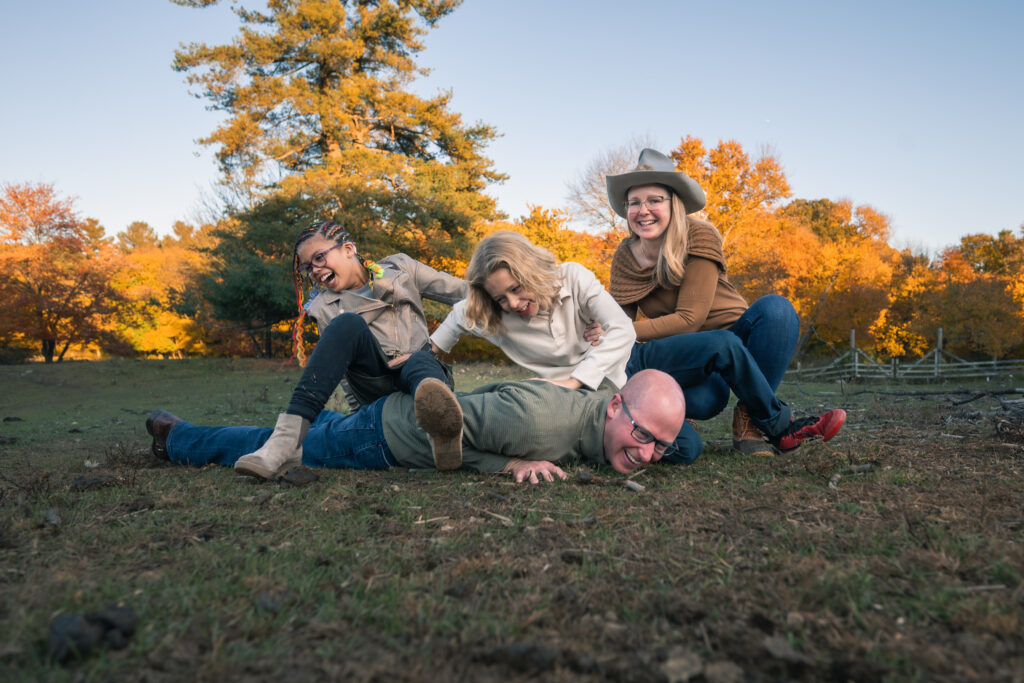
And then without thinking, our eyes met and I made a silly face at him. He laughed. He made one back. And then we were both rolling around on the floor, two gross, exhausted lunatics laughing together in hell. For about thirty seconds, the whole day lifted.
I wasn’t trying to dissolve into the moment. I was ambushed by it.
In a session, this looks like: your kid is sitting in the dirt and won’t get up. You can spend the next twenty minutes negotiating them vertical, or you can get down in the dirt with them. The second you stop trying to fix what’s happening and actually join it, you’re there. And so are they.
Actually Look at Your Kid
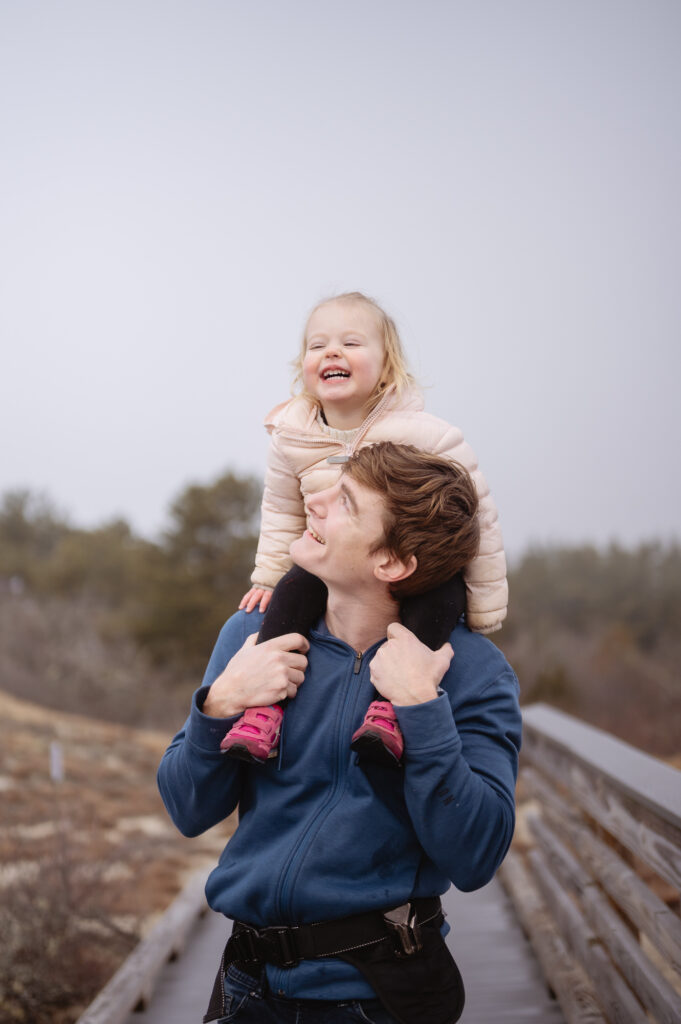
The second way is quieter.
Your kid is not cooperating. You’re starting to spiral. The session is slipping away from the version you imagined and you can feel it.
Then something stops you.
Maybe it’s that their sense of humor is exactly like yours and they just demonstrated it at your expense. Maybe it’s the light landing on their hair in a way you weren’t expecting. Maybe it’s just the specific way they’re standing, the exact posture of this particular child at this particular age, a thing you will not be able to recall with this kind of clarity in ten years.
For a second you’re not managing a session. You’re watching your kid exist.
Awe has a way of shrinking self-consciousness down to size. Not by fixing anything, but by widening the frame until whatever you were contracted around stops being the whole picture. I wrote about this recently after an existential spiral in a Dunkin’ drive-thru on the Merritt Parkway — and what snapped me out of it wasn’t a pep talk, it was looking up and remembering that my kids are the physical manifestation of the Big Bang, riding in a vehicle powered by liquid dinosaurs, and none of us can explain how any of it is happening. If that sounds insane, read the whole thing here.
That’s not a strategy. It’s just what happens when something real pulls your attention fully outward and the self that was bracing for judgment has nothing left to brace against.
The Cow Patty
The third way is the least dignified and probably the most reliable.
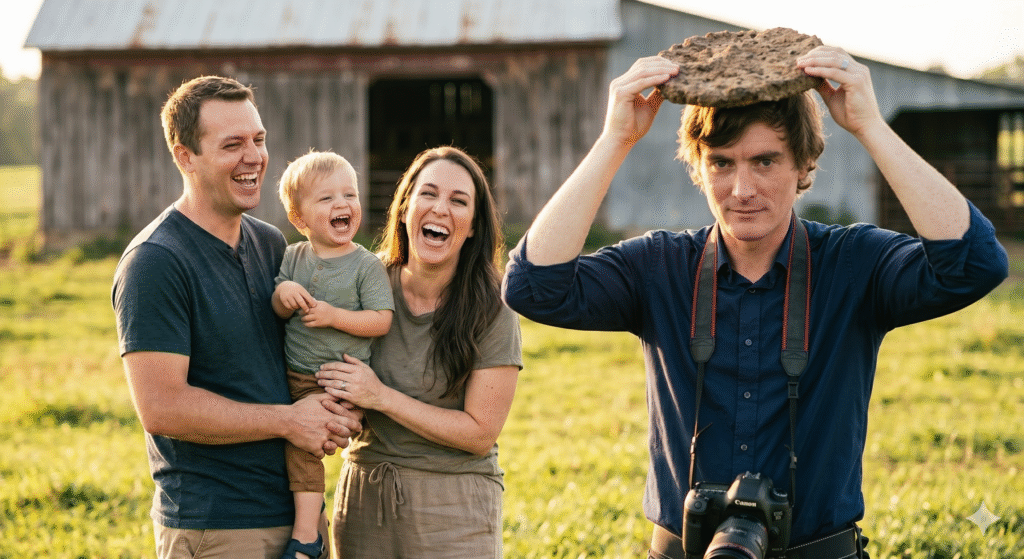
I had a session a few years back that was not going well. The kids weren’t cooperating, the parents were tense, and everyone was working very hard at performing the idea of a happy family instead of just being one.
I looked down. Right next to me was a perfectly dry cow patty. Without really thinking about it, I picked it up and put it on my head like a hat. Then I turned to the girls and asked, very seriously: does anyone like my new hat?
They stared at me for a second.
Then they lost it.
The mom cracked up. The dad cracked up. Within about thirty seconds everything shifted. Nobody was performing anymore. Some of the best photos from that session came right after.
You have a version of the cow patty available to you at every session. You know what makes your kid partner or self laugh.
Do the thing. Then they lose it. And you’re both somewhere else entirely.
What This Means for Your Session
The through line in all three of those is the same: when you stop managing and start actually showing up, something shifts. The photos that end up mattering almost never come from the moments of greatest effort.
But what if it’s just you?
When It’s Just You and the Camera

Headshots, senior portraits, branding sessions. No kids to chase. No built-in chaos. The self-consciousness has nothing to compete with.
So you build the conditions for presence deliberately.
Know what you’re walking into. The anxiety makes sense. You now know why it’s there, and that alone takes some of its power away. Think about what actually puts you in flow. A playlist on the drive over. A conversation you had this week that made you feel like yourself. Have something like that ready.
Do the physiological sigh Two quick inhales through the nose, one long exhale through the mouth. It’s the fastest way to activate your parasympathetic nervous system. Not a metaphor. Actual biology. Do it twice.
Bring someone. Not for moral support exactly, though that helps. For attention. When your best friend is standing six feet away doing something stupid, your attention goes there. The part of your brain that was monitoring your face just stops doing that. It works better than any posing instruction I’ve ever given.
Choose your photographer deliberately. You are allowed to pick someone you actually like. Someone whose energy matches yours. Someone funny, or calm, or both. Someone who has already made you feel at ease even if you’ve only exchanged a few emails. The relationship matters more than the portfolio. You can usually tell within five minutes of meeting someone whether they’re going to make this easier or harder.
Surrender the result. You can show up prepared, bring someone, do the sigh, choose the right person. After that, the result isn’t entirely in your hands. That’s not a cop-out. That’s the actual practice. With anything.
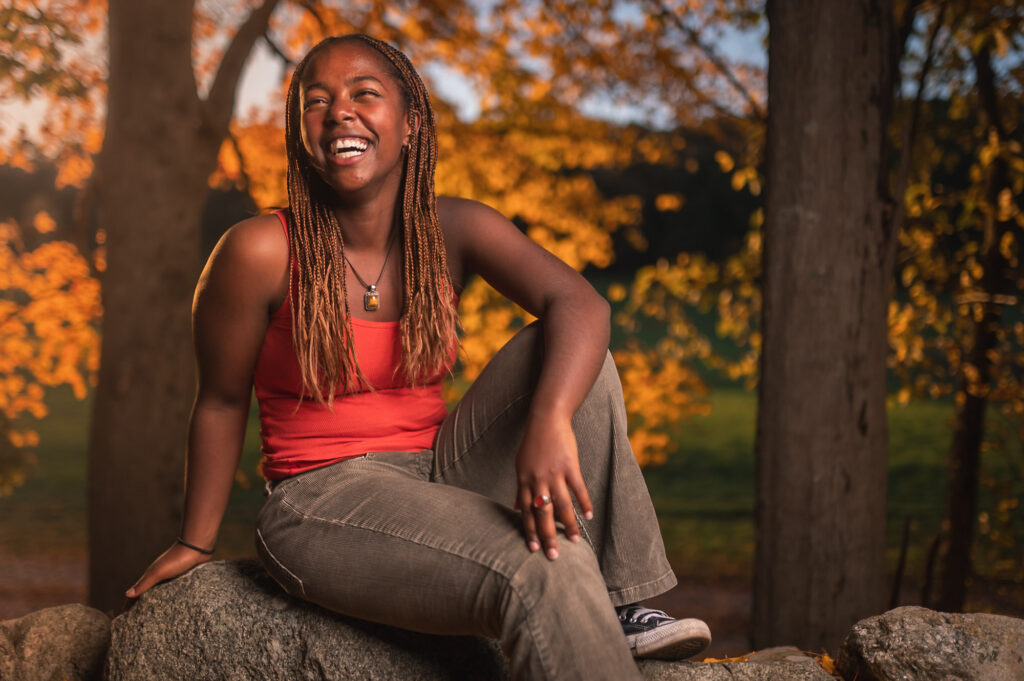
The people who arrive telling me they hate photos of themselves are usually the ones who end up with the photos they love most.
Not because I convinced them of anything. But because at some point during the session, something pulled their attention somewhere else. The part of them that was so busy being evaluated quietly stepped aside.
What came through instead was real.
If you’re drawn to the deeper end of this stuff — presence, philosophy, what it actually means to show up for your life — my newsletter is where I write about it. You can browse the archive here or sign up here.
Considering a headshot or branding session? This page explains what to expect.
Want to see what a family session at the farm actually looks like? This page walks through the whole thing.