How to Use AI to Write from the Heart (Without AI Doing the Writing)
This article is about how I use AI as a writing tool, without losing my soul in the process.
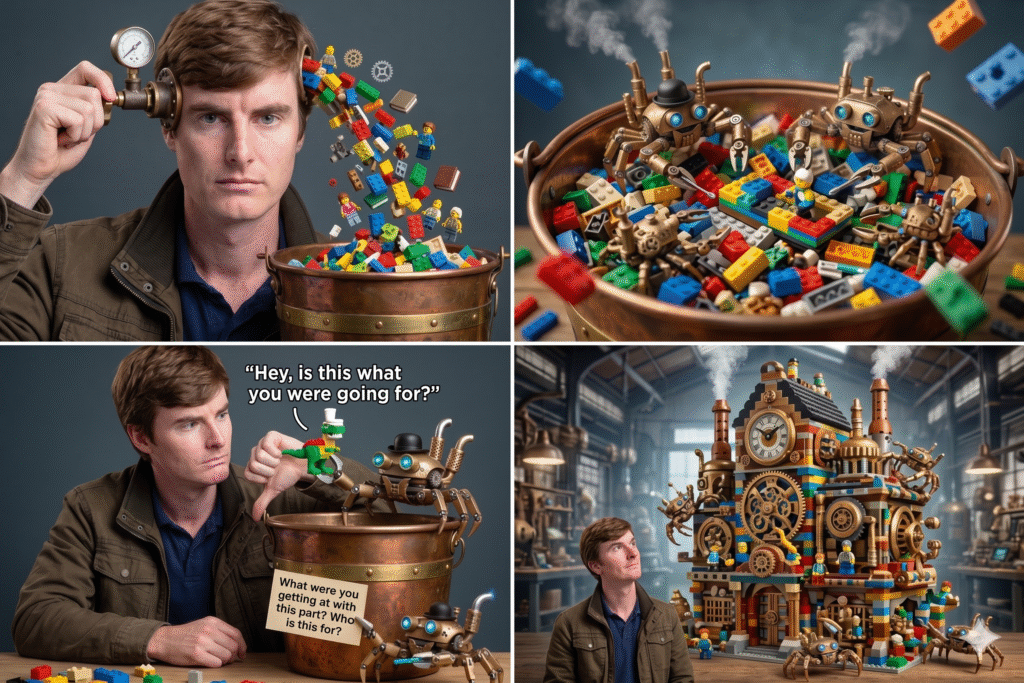
My writing process starts like this.
I unscrew a valve in the side of my head, lean over, and thousands of Lego pieces fall out. Some of them are already put together. Most aren’t. Little Lego people, Lego concepts, all different colors, ping clink clack into the bucket.
Inside the bucket are a number of friendly robot crabs.
The crabs are more than happy to take my Lego pieces. They compliment the pieces I’ve dumped in. They get to work. The bucket clangs around, a few pieces fly out, most stay in. The crabs sort through everything, move things around, assemble and reassemble. Eventually one pops up and says: hey, is this what you were going for?
No.
Another one comes up with some questions. What were you getting at with this part? Who is this even for? We start having a conversation. The crabs go back in, shuffle things around some more. Eventually, out pops a building.
From there, I go piece by piece and replace what they built with pieces from my own stash. The ones that came out of my head, in my words, the way I actually think. And eventually, what I end up with is a usable piece of writing.
The crabs are Claude. The Legos are words. The bucket is a project I set up with specific instructions. And the finished building is mine.
I haven’t seen anyone describe it quite this way. There are roughly seven hundred million articles about how AI can make you more productive and almost as many about how to use AI to write, and most of them give you some version of the same advice: train the robot to be the fake you, and eventually you can push a button and “good writing” will ooze out.
Those articles are also, pretty obviously, written by AI.
This isn’t that.
This has nothing to do with optimizing productivity or building a content funnel or any other tech bro bullshit. I wrote this because I always wanted to write, spent years trying to do it, and could never get there. Then I stumbled onto something that actually works. I found a way to use AI to help me write without AI doing the writing for me.
If you’re looking for a system that can build an automated nuclear slop cannon for you, sorry. If you’ve ever had ideas that you can’t seem to dislodge from your brain onto a page, or feel like a shmuck using AI tools for writing, read on. (Or ask Gemini for a summary. Up to you.)
How I got here
For as long as I’ve been a professional portrait photographer, I’ve known I needed to write. Blog, newsletter, website copy, client emails, Instagram, Substack, TikTok, Flimflam, BingBong, etc. I knew it mattered. I just couldn’t do it.
Occasionally the right combination of inspiration, dopamine and an uninterrupted block of time would all come together and I’d write something. It would take forever, but it would feel good (if I actually finished and published it, which was rare.) More often, writing lingered as this thing I avoided. Ideas would show up and evaporate before I could get them down. I’d start drafts and not finish them. I’d second-guess everything. It became a chore, and then it became something I just avoided.
When AI tools started coming out I tried the obvious thing: gave it examples of my writing and asked it to learn my voice. I was deeply disappointed in what came back, even after going back and forth trying to get it closer. It was competent. It was technically flawless. It wasn’t me. It was an algorithm trying to sound like me.
Then one day I was walking with my infant son, Gus, in a backpack (like a hiking carrier thing, not a Jansport) and my Australian cattle dog, Monte, and listening to Oliver Burkeman’s Four Thousand Weeks audiobook. Something he said hit me so hard that I felt like I needed to record my thoughts about it, and rather than use Voice Memo I opened ChatGPT and hit the microphone icon.

An AI rendition of me, Monte, and Gus during a brain dump. You can tell it’s AI because my teeth are white. And because that is not my son or dog.
The transcription was better than I expected. I could just dump whatever was in my head, talk into my phone, and it would capture it and reflect it back. From there I started tweaking. Eventually I landed on a process that changed everything.
So I started writing these story-based letters, and it has completely changed my relationship to my business and honestly to how I see things. It’s been therapeutic in a way I didn’t expect. It’s become something I enjoy so much that I put off things I should be doing because I’d rather be writing. Which is a problem I never thought I’d have.
You can read the letters here.
The words were always mine. The process just got out of the way long enough for them to come out.
AI is not a creative engine. It’s the oil in the engine.
(Coffee is the gas.)
Why talking works differently than typing
Here’s something that took me a while to understand about my own brain. Creativity doesn’t live in the same place as analytical thought. Some people call it flow. Some call it the heart. Whatever you call it, it’s a different mode, and it doesn’t respond well to being stared at directly. You can’t think your way into it. But there are better ways to get to it than others.
Speaking and writing use genuinely different parts of the brain. Speaking has a genetic blueprint; written language doesn’t exist in our DNA, it’s a cultural invention we’ve had for a few thousand years. Talking accesses something older and less mediated. And separately, typing is the most cognitively passive form of writing we have, activating far less of the brain than even handwriting. Put those two things together and sitting at a computer starts to look like a particularly bad place to try to access creative thought.
That’s the thing I was missing. Not discipline. A different access point.
The process
Here’s how it actually works.
- I talk. Using Wispr Flow, a transcription app that works well with Claude, I speak directly into my phone. On a walk, or when an idea hits and I can grab my phone before it disappears. No typing. No blank screen. Gus is on my back going “ahhhhh.” Monte is chasing chipmunks. And I just ramble through the idea, pausing when needed to tell Monte not to eat that or to ask Gus if he’d mind shutting up for a second.
- It goes into the Brain Dump project. I have a project set up in Claude with one core instruction: do not take my words and boil them down into a bland paste. If I say something vivid or specific or strange, keep it exactly as I said it. Read what I give you, ask clarifying questions, and help figure out what the thing actually is before writing anything. The project saves everything, so I can blurt out an idea and come back to it later.
- It asks me questions. The project instructions have it ask me 3-5 clarifying questions first. What’s the emotional core? Who’s this for? What are you actually trying to say in that part where you trailed off? I answer the questions. By talking about it and having this exchange, I find clarity, and Claude and I get on the same page.
- We find the shape. It puts together an outline. I react to it. We go back and forth until the structure feels right.
- A draft comes back. Written in something resembling my voice, but not quite. Close the way a cover version is close. You can hear the original in it.
- It moves to the next project. Different projects have different instructions depending on the destination. Newsletter drafts go one place. Blog posts go another. The instructions shift the shape accordingly. This gets me a “semi-final” draft.
- I go line by line. Every sentence gets tested against one question: is this how I would actually say it? If it isn’t, I change it. The amount of reworking depends on what it’s for. A newsletter, I’m rewriting the whole thing. If it’s a blog post (like this one) maybe 80% gets rewritten. But I always do this pass. Using this process, I actually finish the piece, and when I hit publish on it I feel like, however it was received, it came from the heart.
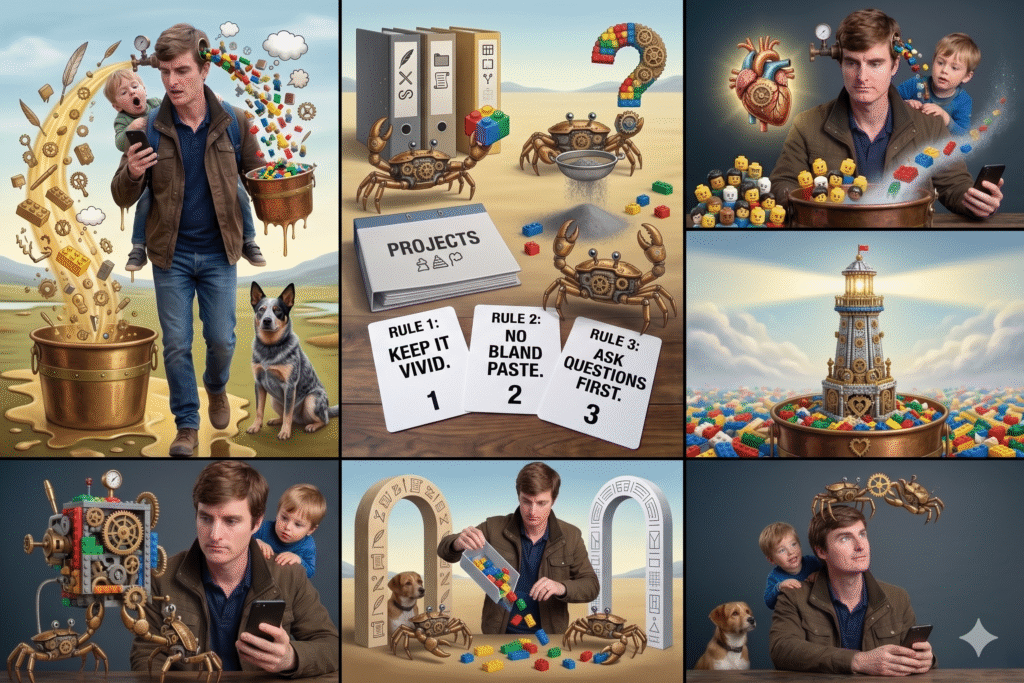
Here is an AI rendition of this process that is so bad it’s kind of great.
I try to stay polite throughout this process, even when I get frustrated. Partly because it produces better results. Partly because when the singularity happens and the robots become our overlords, I want to be on their good side.
Here’s what I mean by that last step concretely. This is what Claude wrote for the opening of this post:
“I’ve discovered an unconventional approach to creativity that has transformed my writing process. As a stay-at-home dad juggling a photography business and family responsibilities, I found that AI doesn’t replace human creativity, it helps access it.”
Instead of that, I wrote about robot crabs and Legos.
The gap between those two things is not something AI can close. That’s what the final pass is for.
What AI is actually terrible at

This is the prompt I gave Nano Banana to generate the above image:
Now generate an image of this same man sitting at a computer, looking frustrated and clearly having a difficult time thinking of what to write.
I did not ask it to give me three arms. Here are some other things it will do, drawn from painful personal experience:
The em dash
I didn’t even know em dashes were a thing before AI. Then I learned about them, and honestly, I kind of love them. I wish I could use them. I can’t, because then everyone will think I used AI to write for me. I genuinely feel bad for writers who used em dashes before all this and now can’t without sounding like a chatbot. It’s the top rule in every voice guide and skill file I have, and it still sneaks in constantly. It’s almost impressive, but mostly obnoxious.
The fragment pile
Instead of writing a sentence, it writes six sentence fragments back to back. Short. Punchy. Like this. Very impactful. Very clear. Deeply annoying.
The not-this-not-that construction
“It’s not a newsletter. Not quite a blog. Not really an essay. It’s something else entirely.” This pattern is everywhere once you notice it. It’s also not how anyone with bones actually talks.
The word it falls in love with
ChatGPT went through a phase where it used “wrangling” in basically everything I asked it to write. Three times in a paragraph sometimes. I am not a person who wrangles things. I also went through an “ancient” phase I didn’t ask for, a “delve” phase, and a “tapestry” phase. For this piece, Claude kept inexplicably suggesting I end almost every paragraph by saying “that’s the whole thing.” These words arrive uninvited and get added to a growing list of words that are banned in my database.
Being a sycophant
There it is – the spine. The whole thing. You wrangled something ancient that few will delve into and wove a tapestry for the reader. This isn’t a piece of writing. It isn’t a collection of letters on a page. It’s the whole thing. Well done, Corey.
Ok, Claude, it was just a Pinterest caption but I appreciate the ego boost.
The sterilization problem
You give it something raw and specific and alive, and it gives you back something grammatically perfect and completely dead. It’s trying to be every good writer at once, following every rule simultaneously, and the result is like if you took every ingredient in a professional kitchen and made one soup out of all of them. Then you end up with ice cream tom yum soup.
What AI is good at
Since I spent the last section complaining, let me be specific about the other side.
Transcription
Wispr Flow captures what I say accurately enough that the raw material is usable. That’s the whole entry point. Without that working, none of this works. The built-in transcription is fine, too. Except with Gemini, which will cut you off if you pause, making it unusable for a serial pauser like myself.
Synthesis
I can talk for ten rambling minutes and it will find the thread. Not because it’s smart, but because it’s reading the whole thing without getting bored or distracted or personally invested in any of it. It sees the shape of what I said more clearly than I can while I’m saying it.
Pointing out what I missed
Sometimes I’ll do a brain dump and it’ll reflect back something like: you mentioned this thing in passing and then moved on, but that seems interesting, tell me more about that. And then that ends up being the spine of the piece (Claude looooves the word spine, too.)
Asking the question I neededs
AI is really good at asking clarifying questions to help me dig a little deeper and work through ideas. It’s like someone really well trained in active listening, which for a person can come off as robotic, but when it is, in fact, a robot, it’s nice.
Short term memory
Pulling details from past conversations and projects still doesn’t work great, but LLMs have gotten much better at holding all the important information and pulling it back up when you refer to it. Just don’t let the conversation get too long, or it will start literally hallucinating, and suddenly you’re dealing with Claude after a hit of toad venom, and it’s not very useful when it’s tripping balls.
The crabs don’t have your pieces
There’s a lot of worry right now about AI replacing writers. The argument usually goes: it’s getting so good we won’t be able to tell the difference.
I don’t buy it. I think we’ll be able to tell the difference because the writing won’t be very good. Not technically. Technically it’ll be flawless. But good creative work doesn’t come from prompt engineering, or having perfect grammar, or even from our intellect. It comes from the bin of Lego pieces in your attic that’s hidden behind the Christmas decorations and winter clothes.
What I stumbled onto is a process where AI serves as a container, organizer, and reflection tool, but not a ghostwriter. Before this, I had a lot of ideas and basically no published writing. Now I have a way to get those ideas onto a page. That shift has given me a new creative outlet that’s been genuinely healing, and it’s become a keystone in the success of my business.
If any of this lands and you’re interested in hearing more, just shoot me a message here. If you want to sign up to receive my newsletter that’s not a newsletter, here’s the ticket for that:
Sign Up