How to Prepare for a Bar or Bat Mitzvah (A Guide for Parents Who’ve Already Thought of Everything Else)
This guide isn’t about logistics. You’ve got those. It’s about how to actually be inside the day when it arrives. So the photos, the memories, and the kid in front of you don’t slip by while you’re managing everything else.
You’ve been planning this for over a year. Maybe two.
The venue. The DJ. The candle lighting order. The seating chart that has already changed four times and will probably change again. The kippot. The centerpieces. The photo collage. The menu. The gluten-free menu. The second gluten-free menu because someone mentioned cross-contamination risk in the Facebook group.
You have a binder. Or a spreadsheet inside a folder inside a Google Drive that has its own folder structure. You have vendors you trust, vendors you’re cautiously optimistic about, and one vendor you’re keeping a close eye on.
You’ve thought of basically everything.
And yet.
There’s something underneath all of it that doesn’t fit in the binder. A feeling that’s harder to name than “stressed” or “excited.” It shows up at 2am when the planning brain finally goes quiet.
Please let this go the way I imagined. Please let everyone have a good time. Please let my kid feel celebrated and not mortified. Please let it all be worth it.
That’s what this guide is for.
Not the logistics. You’ve got those handled.
This is about how to actually show up for the day itself. How to be in it instead of managing it, so you walk away at the end of the night feeling like you were actually there.
Three Words Your Kid Has Been Studying (That Also Apply to You)
A few years ago, an aunt of mine did one of those genetic ancestry tests and found out my grandmother was 100% Ashkenazi Jewish. She’d kept it secret her whole life. The family had moved from France to Brazil before the war. The pieces clicked into place.
I found out I was a quarter Jewish in my forties, from a cotton swab.
I’ve thought about that a lot while photographing mitzvahs. Because what I keep finding, standing in these spaces with a camera, is that the tradition your kid has been studying is full of ideas I’ve been circling my whole life without knowing what to call them.
Three of them live right at the heart of this day.
Simcha. We translate it as “joy,” but that’s not the whole thing. Rabbi Jonathan Sacks wrote about the distinction: happiness is an attitude toward life as a whole. Something you build up over time. Simcha is different. Simcha lives in the moment. Right here, right now, in this room, with these people. You can’t produce it in advance or store it up for later. As one teacher put it: we cannot force simcha. We can only beckon it.
Hineni. It means “here I am,” and it appears at every turning point in the Torah. Moses at the burning bush. Abraham at the moment of his greatest test. It’s not a declaration of location. It’s a statement of total presence. Not “I am here” like answering roll call, but “I am here, fully, completely, for whatever is about to unfold.” Your kid has been studying this word. It’s worth sitting with what it would mean to bring that same quality of presence to the day yourself.
Bitachon. Trust. More specifically: you do your work, your preparation, your planning, and then you release the outcome. The binder, the vendors, the seating chart, the two years of decisions. That was your part. The day itself is where you let go. As one Jewish teaching puts it: our job is to try, to do our part with full effort, and then leave the results in hands larger than ours.
These three aren’t separate ideas. They’re the same idea from three angles.
Do the work. Show up fully. Trust what unfolds.
And here’s the plainest version of it I know, which I’ve had to learn the hard way more than once in my own life: to have regret about how things turned out, or to take ownership of an outcome when you showed up and did your best, is a form of suffering we all practice but none of us actually need.
The planning was always just the scaffolding. The day is the building.
What You’re Probably Carrying Into This
I’ve shot mitzvahs as a second shooter where I could feel the tightness from the moment we arrived. The parents smiled when a camera pointed at them. But between moments there was an antenna up, tracking everything, making sure the day was going the way it was supposed to go.
I watched a father give a hotel manager a hard time about something small. And I understood it immediately, because I’ve been that person at my own events. When you’re managing an entire day of details, the small things become where the pressure goes.
The candid photos from a day like that are harder to find. Not because the love isn’t there. It always is. But people who are managing a day can’t also be inside it. Those are two different jobs and they can’t happen at the same time.
I photographed another mitzvah just a few days after my son was born. I was running on something close to fumes, operating mostly on autopilot. It turned out to be one of the most joyful events I’ve ever shot.
The parents had decided, consciously or not, to just be there.
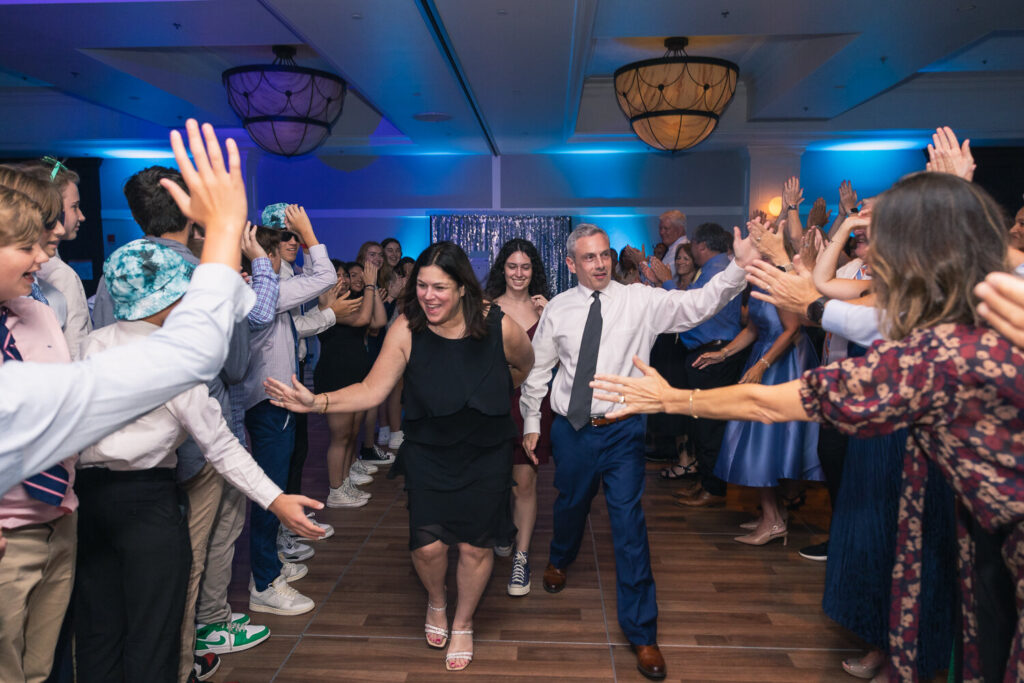
They were on the dance floor. They got to spend a few hours with their closest friends in one room. They laughed a lot. Their kid, picking up on all of it, was relaxed. Really relaxed. Just a kid at his own party, lost in it.
The photos from that day have real moments all through them. Not because I did anything different. Because the family did.
A Word on the Kid
I didn’t have a bar mitzvah. I’m not the right person to speak to the religious weight of what your kid is about to do.
But I was 13 once. And I remember it with a combination of tenderness and mild horror.
I was 13 when my parents got divorced. I went from a small school where I knew everyone to a large public school where I knew nobody and didn’t fit in. I had ADHD nobody had caught yet, so I just assumed I was bad at school. I was going through all the standard-issue adolescent chaos with not enough adults in my corner.
I’m not saying this to be heavy. I turned out mostly fine. But I think about it when I’m photographing kids this age, and I want to say something honest.
Being 13 is a lot. For a lot of kids.
And a bar or bat mitzvah asks something unusual of a 13-year-old. You’re being publicly celebrated in front of a room full of people, some of whom you don’t really know, while wearing a new outfit and trying to remember what to do with your face. You’ve had to study and prepare and perform in ways most adults never have to. And now everyone is telling you what a remarkable young person you’ve become.
Meanwhile you’re a teenager who mostly wants to be somewhere else.
Underneath all of that, though, for a lot of kids, it’s also genuinely meaningful. The Torah portion. The prayers. Being called to the bimah as an adult member of the community for the first time. That’s real. A lot of kids feel it even when they can’t say so.
So your kid is holding a lot at once.
This guide probably won’t reach them directly. They have enough reading to do. But maybe something here helps you understand what they’re carrying, so you can be one of the adults who makes the day feel lighter instead of heavier.
The most useful thing you can probably do is simple: let them feel whatever they feel. Don’t need them to be having a great time. Don’t manage their experience. When something is hard, let it be hard. When something is funny, let it be funny.
Just be with them. That’s the whole thing.

What Gets in the Way
It’s the same thing that gets in the way of a good family photo session. A good wedding. A good holiday. A good anything.
The fixed idea of how it’s supposed to go.
My wife and I joke, or half-joke, that planning our wedding was the closest we ever came to not making it. The planning became its own stress test. I think that’s true for a lot of couples, and for a lot of mitzvah families too. You pour so much into making the day right that somewhere along the way the day stops being the point.
The day is always the point.
The planning is just how you get there.
Underneath the tightness, underneath the checking and the tracking and the making sure, is usually some version of: what if I didn’t do enough? What if I’m not enough? The centerpieces become a proxy for the question you can’t ask out loud. The small details become the place where the big fear lands.
You can do everything right and still spend the whole day inside that fear instead of inside the simcha.
What Actually Helps
You’ve done the work. The vendors are booked. The details are in place.
At some point in the next day or two, the event begins.
That’s when your job changes.
You planned it. You don’t have to live inside the planning anymore. Those are two different jobs and they can’t happen at the same time.
The new job, starting the moment the day begins, is just to be there.
Not to manage. Not to evaluate whether things are going the way they were supposed to. Just to be a person at your kid’s party, in the room, with the people you love, inside the thing that is actually happening.
That’s how you beckon the simcha.
A few things that actually help when your brain refuses to cooperate:
The physiological sigh. Two quick inhales through your nose, then one long exhale out your mouth. It sounds almost insultingly simple. It works. Your nervous system responds whether you believe in it or not.
A mantra. Something short you can return to. “Now. Here. This.” Or “I’ve done my part.” Or “Let it be what it is.” Pick something before the day starts so it’s available when you need it, not something you have to invent during the hora.
Find your kid. Not to check on them. Not to fix anything. Just to look at them. Their face. Their expressions. The specific, unrepeatable way they exist right now, at this age, on this day.
That’s the photo worth having. That’s the thing you came for.
What to Know About Mitzvah Photography (And How to Actually Be Present for It)
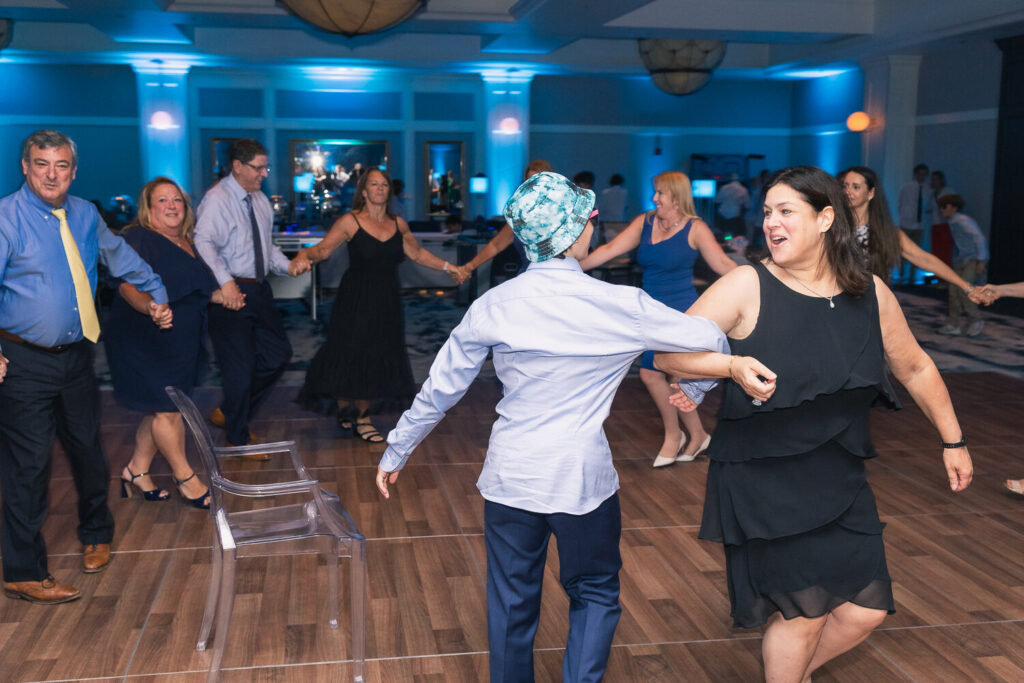
The best mitzvah photos almost never come from the moments when people are trying to look good for the camera.
They come from the moments when everyone forgot the camera was there.
Your photographer is handling the technical side. That’s their job. Your job is not to manage how things look. Your job is to be present enough that something real is happening for them to catch.
A few things that actually make a difference:
Let the portraits just be time together. During family portrait moments, try this reframe: you’re not trying to look a certain way. You’re just spending a few minutes close to each other, paying attention to each other. A good photographer can work with that. What they can’t work with is tightness.
Give your kid real ownership over how they show up. Their outfit choices, how they want to stand, what makes them comfortable. When people have genuine agency over their own appearance, they carry themselves differently. More like themselves. It shows.
Leave your phone somewhere inconvenient. You hired someone to document this. Let them. The moment you’re trying to document it yourself, you’re watching the day through a screen instead of being in it.
For anyone navigating the extended family portrait portion of the day, which can be its own particular adventure, I wrote a full piece on making those feel less like a military operation and more like an actual moment between people.
You’re Crossing a Threshold Too
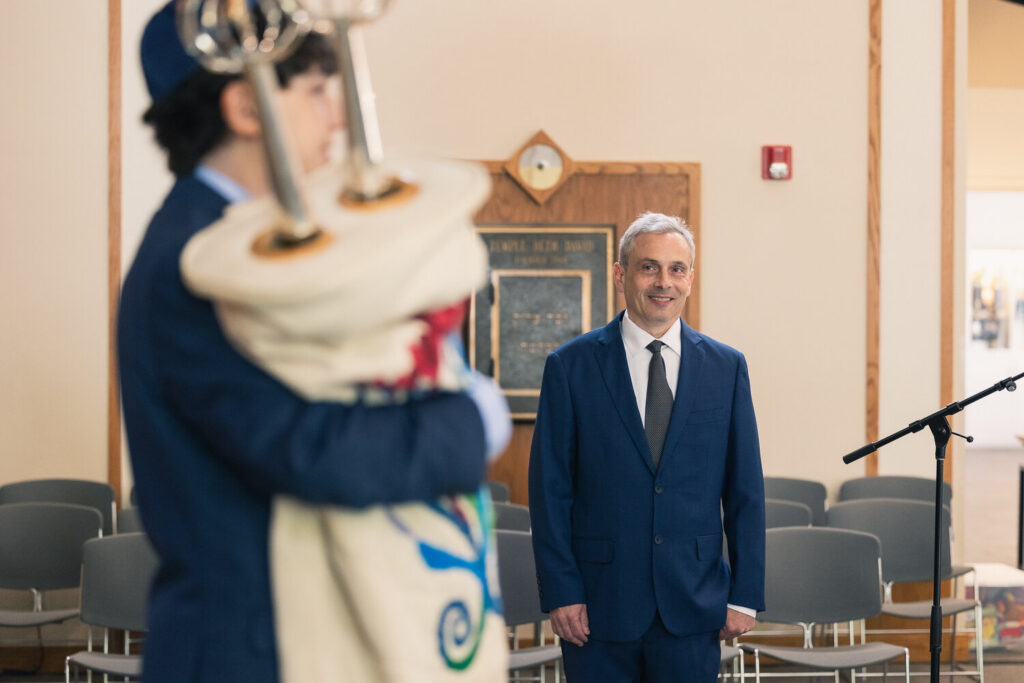
A bar or bat mitzvah is a rite of passage for your kid. Everyone knows that part.
What gets talked about less is that it’s also something for you.
You raised a person to adolescence. You showed up for thirteen years of ordinary days, hard days, funny days, days when you weren’t sure you were doing any of it right. You worried about them and celebrated them and figured it out as you went, which is the only way anyone figures out any of this.
And now they’re standing at the bimah.
That belongs to you too.
So when the wave of something bigger than you expected hits, during the candle lighting, or the hora, or some completely random moment you didn’t see coming, let it come.
That’s not losing it. That’s showing up.
I’ve been thinking about the word “holy” lately. It might be related to the word “whole,” and wholeness doesn’t mean everything is perfect and nothing is hard. It means all of it at once. The joy and the exhaustion. The pride and the strange grief of watching your kid step away from you into something new. The love that doesn’t quite fit inside your chest.
That’s what this day is.
All of it at once.
Let it be whole.
One More Thing
Simcha, hineni, bitachon.
Do the work. Show up fully. Trust what unfolds.
Here’s what I’ve seen beckons the simcha, every time: when the people at the party stop trying to produce the party and just become part of it.
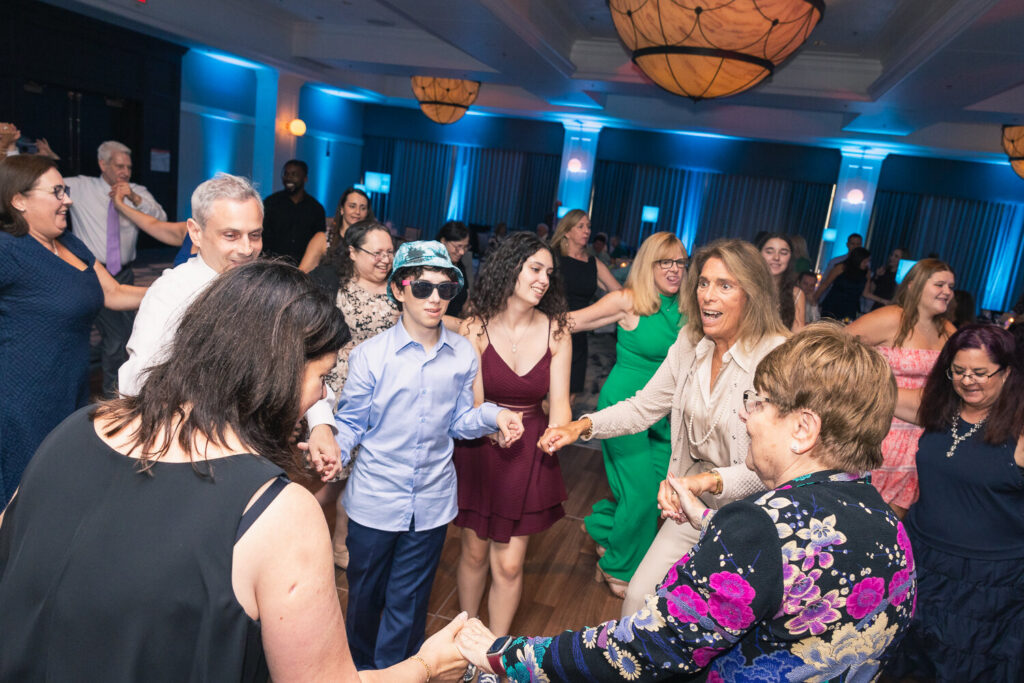
When the parents are on the dance floor. When someone says something that makes everyone at the table lose it. When your kid catches your eye across the room and you just look at each other for a second.
You planned for a year to make those moments possible.
You don’t have to do anything else now.
Just show up and let them happen.
I’m a mitzvah photographer based in Lincoln, MA, serving families across the MetroWest Boston area. My focus is the real moments. The ones that happen when families stop performing and start actually being together. If you’re looking for a photographer who approaches the day this way, I’d love to talk.
Contact me here or learn more about how I work.
P.S. This guide is part of a series. If you found this useful, the family session version lives here. Guides for senior sessions, maternity, and newborn are coming.