What to Wear for a New England Family Photo Shoot
You’re thinking about getting some family portraits taken, and now you’re staring at your closet wondering what the hell everyone should wear.
This question tends to go one of two ways. For some people, it moves to the forefront of their mind immediately and steamrolls over more important questions like “how do we get there” and “did I feed the children today.” For others, it doesn’t occur until the last minute, at which point a frenzied whirlwind of clothes-changing ensues and everyone arrives looking like they fled some sort of imminent disaster.
Either way, I want to start by saying this: figuring out what to wear for family photos is really not that big of a deal. You’re taking some family photos on a farm, or in a field, or somewhere beautiful in New England. If you have a good family photographer, you’ll play together, enjoy the experience, and end up with images that feel like your spirit comes through in them.
You’re not meeting the pope. You’re not testifying before Congress. I promise that when you’re on your deathbed, you won’t be thinking about whether you should have worn the rust-colored blouse or the navy one.
What really matters is that what you wear doesn’t become a barrier to being fully present during your shoot. The wrong clothing choices can create discomfort, anxiety, or straight up misery that can be hard to overcome no matter how fun the shoot is or how good of a family photographer you have.
So. Let’s talk about what to wear, and what not to wear.
Step One: Wear Clothes
You should wear pants, or a skirt, or a dress. You should wear a shirt, unless the dress already covers that. You should wear socks, and shoes of some kind, and almost certainly underwear. Basically, you’re going for clothes. The kind a person wears when they go somewhere. You’ve done this before.
“No shit,” you say? Well, stay with me here.
The bar for “acceptable outfit” is much lower than you think. It is not a fashion show. It is a family photo session, and the goal is to look like yourself, just a version of yourself that didn’t just roll out of bed or escape from prison.
What to Wear
Physical Comfort
The clothes everyone is wearing should allow them to bend, squat, dance, run, jump, and do whatever else a good photographer is going to ask you to do to shake off the stiffness. Because if you’re any good at picking a photographer, you’re going to be moving around.
Comfort also means temperature. It’s hard to look relaxed when you’re on the verge of hypothermia. Even an ugly jacket that nobody is actually wearing in the shots is worth bringing along so people can warm up between setups.
Don’t force kids to wear something they hate or that’s uncomfortable. A suit jacket on a two-year-old is genuinely adorable, and also, if they hate wearing it, you are going to end up with photos of a beautiful jacket on a miserable person. The jacket will look great. Your child will look like a tiny, furious CEO who just got the Q3 numbers.
Emotional Comfort
There’s another kind of comfort that’s harder to put on a list but shows up just as clearly in photos.
If your six-year-old is fully, incandescently alive when she’s wearing a princess dress, and that’s what she wants to wear, let her wear it. I’d rather photograph a kid in a princess dress who is vibrating with joy than a kid in a perfectly coordinated olive and cream cardigan who is tolerating the experience just long enough to get a lollipop at the end. One of those photos is going to make you cry someday. The other one is going to make you say “she looks cute” and scroll past.
This isn’t really about clothes. It’s about the fact that what shows up in a photo is how someone actually feels, and an outfit that makes a person feel like themselves is going to read better than one that doesn’t, regardless of how well it coordinates with everything else.
The same logic scales up as kids get older, and with teenagers, it gets more complicated. Whether they don’t want to wear something because it’s physically uncomfortable or because it’s genuinely not who they are, the math is the same: you’re starting with someone who already doesn’t want to be there.
If your teenager wears all black and that’s who they are, they can wear all black. If they have strong and consistent opinions about how they look, those opinions are worth factoring in, because what shows up in photos is how people actually feel, and an outfit that feels like them will read better than a coordinated one that doesn’t. The “this is going to be fun” framing, which is worth investing in, does not survive five minutes of fighting about clothes. There’s more on this in my post about how to actually prepare for a family session as a whole family, which goes into giving kids ownership over the process from the beginning.
Coordinate, Don’t Match
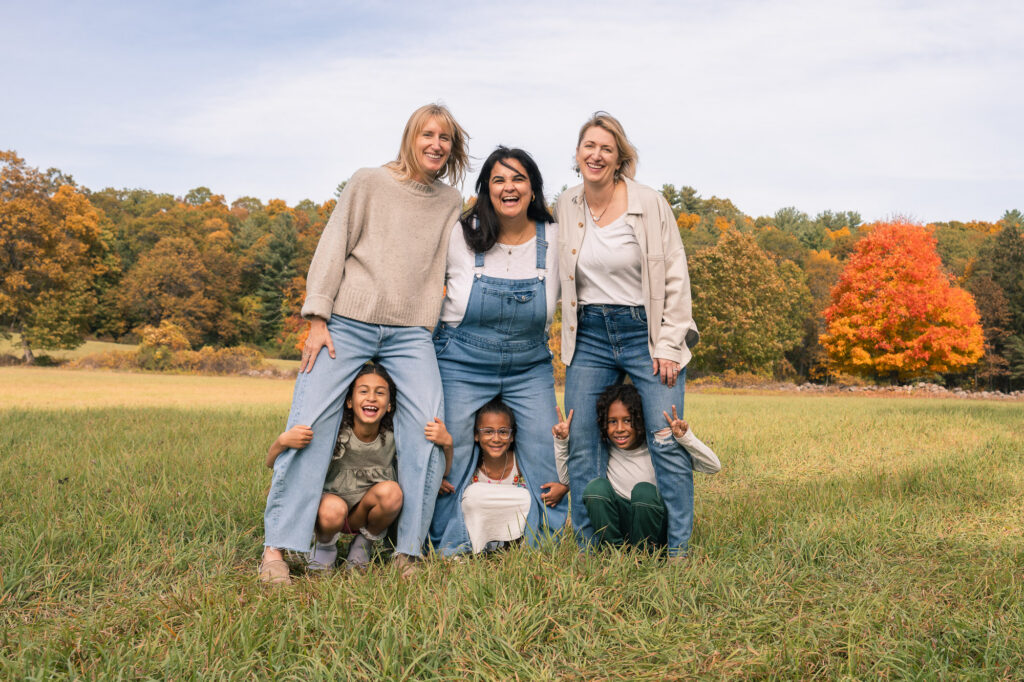
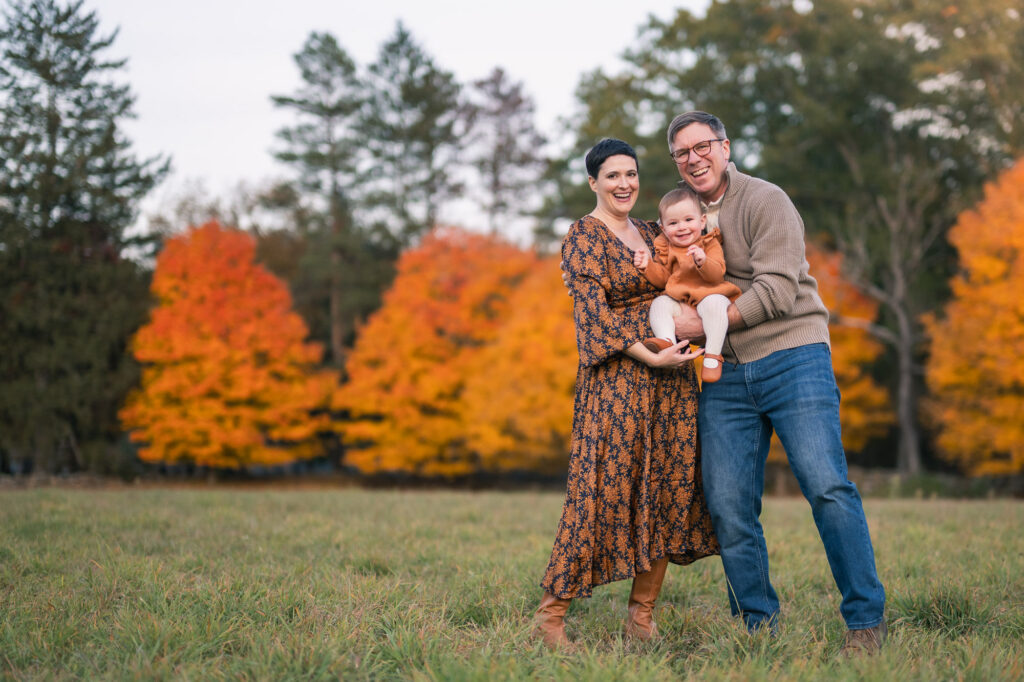
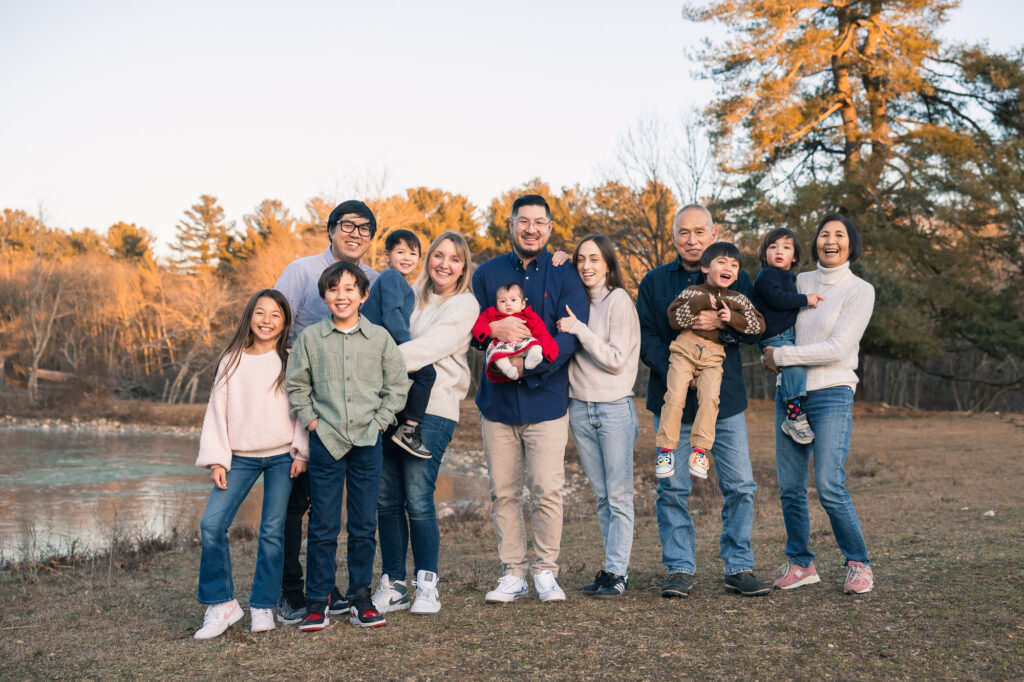
Wearing complementary tones works well. Everyone in muted earth tones, or everyone in jewel tones, or a mix of warm colors that feel like they belong together. What doesn’t work is everyone in soft neutrals and one child in neon orange. That child becomes the entire subject of every photo. Which is fine if you have a favorite, but if everyone is theoretically on equal footing, keep this in mind.
But please don’t have everyone wear the exact same thing. I don’t know where the “white shirts and jeans” trend came from, but it needs to stop. Are you in a cult? You’re a family, not a mandatory team-building seminar for TGI Fridays.
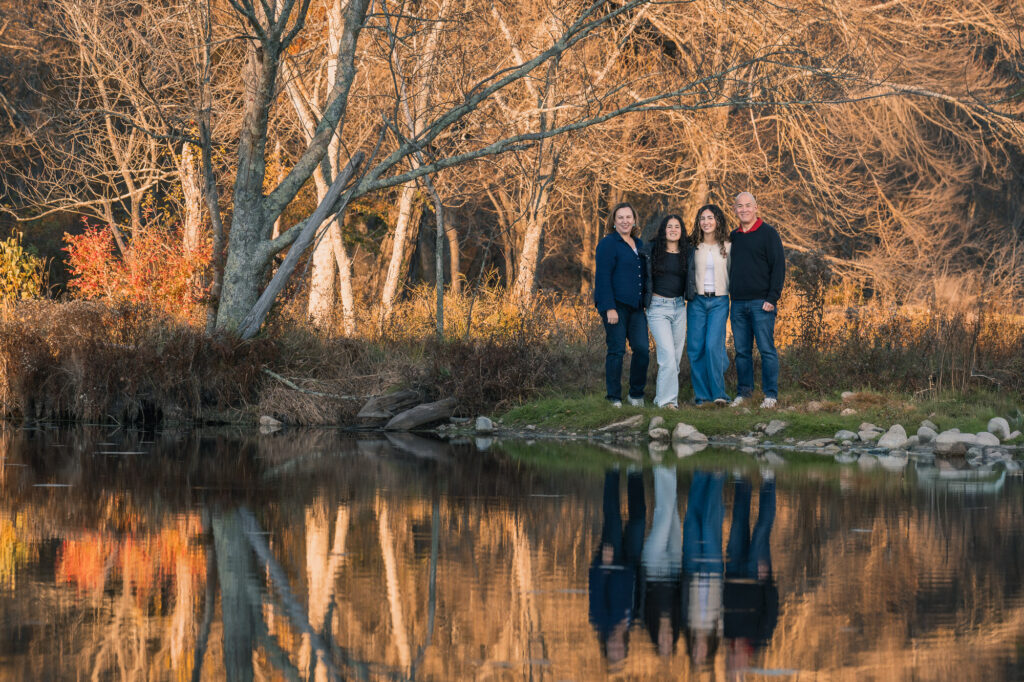
Same goes for “everyone in denim” or “everyone in navy.” When you’re all wearing the same color and you stand together for a group shot, you literally blend into each other. It’s hard to see where one person ends and another begins. You look like a human centipede, albeit a happy one.

Start with One Person and Build from There
Rather than having a fashion free-for-all where everyone picks their own thing and then you spend forty minutes arguing about whether it works, have one person pick their outfit first and everyone else build around them.
If you have kids, get a few appropriate outfits together and let them choose one. Giving them ownership over the decision makes them more likely to cooperate with wearing it. Telling them they can wear whatever they want runs the risk of them showing up in a Batman costume, water wings, and one rain boot. Which, as a photographer, I’d be here for, but you might want something a little different.
One Pattern Suggestion
If someone is wearing a pattern, one guideline is to have everyone else in solids that pull colors from that pattern.
Example: Mom wears a floral dress with navy, blush, and cream. Dad wears solid navy. Kids wear cream or soft pink. The dress becomes the anchor. Everything else just supports it. It looks deliberate without requiring everyone to think too hard.
If two people are in patterns, you end up with some visual conflict, like it’s a Plaid vs Paisley cage match, and nobody wins.
What Not to Wear
Now that you have a sense of what works, here’s what to avoid.
Anything you’re wearing for the first time. If it doesn’t fit quite right, or you’re not sure how it moves, or you’ve been meaning to return it, now is not the time to find out. Wear something you already know works on your body.
Shirts with writing or logos. Your favorite band, your college, the restaurant where you and your spouse had your first date, a motivational quote, your kid’s Little League team. I’m sure it all means something to you. It’s just really distracting in a photo.
Sunglasses. Eyes are where the connection lives in a photo. Sunglasses hide them. Leave them in the car.
A note since this question comes up: wear your glasses. You need to be able to see, and your glasses are part of your face, and if you don’t wear them you’ll look like Milhouse without his glasses. Glare from lenses is primarily a studio lighting problem, not an outdoor natural light problem, and at this point AI editing handles it pretty well anyway. If your photographer is using off-camera flash and running into glare, that’s on them to sort out, not you.
The one actual exception is transition lenses. If you have both regular glasses and transitions, wear the regular ones, because you may have forgotten that transition lenses become sunglasses when you walk outside, and we just covered why sunglasses are a problem.
Hats. They cast shadows on your face and usually create problems with the light. There are exceptions, but they’re rare.
Weird jewelry or accessories. Meaningful jewelry is fine. A big statement necklace that competes with your face is not.
Anything stained or wrinkled. Already covered this above, but it bears repeating: I cannot fix wrinkles in post, and I cannot fix stains. The hanger rule applies.
And the following are strongly not recommended:
- Flesh-colored speedos
- A burlap sack
- A rainbow poncho
- Your aunt’s wedding dress from 1974
- A leisure suit
- A Super Bowl Champions shirt for a team that did not win the Super Bowl
- A steampunk ensemble
- Tactical body armor
- A latex gimp suit (especially one without eye holes)
- A beard of bees
- A T-shirt but no pants
- Sequined leotards
Okay. Moving on.
Hair, Makeup, and Accessories
Hair
You may not think of hair as belonging in a what-to-wear guide. I’ve always considered hair to be the biological clothing of the head, so here we are.
The practical issue with hair at an outdoor session, especially golden hour, isn’t really wind. It’s light. Loose flyaways are generally fine and handleable in editing. What’s hard to deal with is very frizzy or frazzled hair when someone is backlit by the sun, because that combination creates a situation that’s genuinely difficult to fix after the fact. If that describes your hair and your session is in the evening, a little extra product or just tying your hair up is worth considering. Beyond that, you’re probably fine.
On haircuts: do it a week or two before the session, not the day before. A freshly cut look is its own aesthetic and it’s not always the one that photographs best.
Makeup
I will be upfront that I don’t know anything about makeup. I have friends who are professional makeup artists, and I have eyes, and here is my collected wisdom from both of those sources.
The main things makeup can do for a session are the same things it does every day: conceal blemishes, even out skin tone, and reduce shine. If you want to do those things, great. If you like wearing lipstick or mascara, also great. What I’d push back on is feeling like you need to do something different or more elaborate than what you normally do just because you’re being photographed. The goal is to look like you, and more is not automatically better in natural light.
Worth knowing: a lot of photographers, including me, can add hair and makeup styling as a service to the session. If that sounds appealing, just ask.
Accessories
Meaningful jewelry works. A necklace with history behind it, rings you wear every day, earrings that feel like you. These show up in photos and they should, because they’re part of how you present yourself to the world.
The general principle for accessories is the same as everything else in this guide: if someone likes it and wants to wear it, they should wear it. If your kid wants to wear their plastic New Year’s Eve glasses (even though it’s July) because they love them, those glasses are probably going to be in some of the photos. Honestly, fine. A kid in something they love is a better photo than a kid in something coordinated that they couldn’t care less about.
What photographs less well is anything very large, very reflective, or so designed-to-be-noticed that it becomes the first thing anyone looks at. A statement necklace is engineered to be seen first, and in a family portrait, the first thing someone sees should probably be a face. But even this is a loose principle, not a rule, and if someone’s going to be unhappy without it, keep it.
What to Wear by Season in New England
New England weather is unpredictable at best and actively hostile at worst. Here’s what you need to know for each season.
What to Wear for Fall Family Photos 🍂
Fall is the busiest season for family photos in New England, and for good reason. The light is beautiful, the foliage is incredible, and the weather is theoretically perfect.
I say theoretically because New England weather is a lying bastard.
Here’s a true story: a family books in September when it’s 70 degrees and sunny. They show up in October and it’s 45 degrees at 8 AM, and because they ran out the door, they forgot jackets. So now their 8 year old son is wearing my wife’s purple down jacket and isn’t thrilled about it.
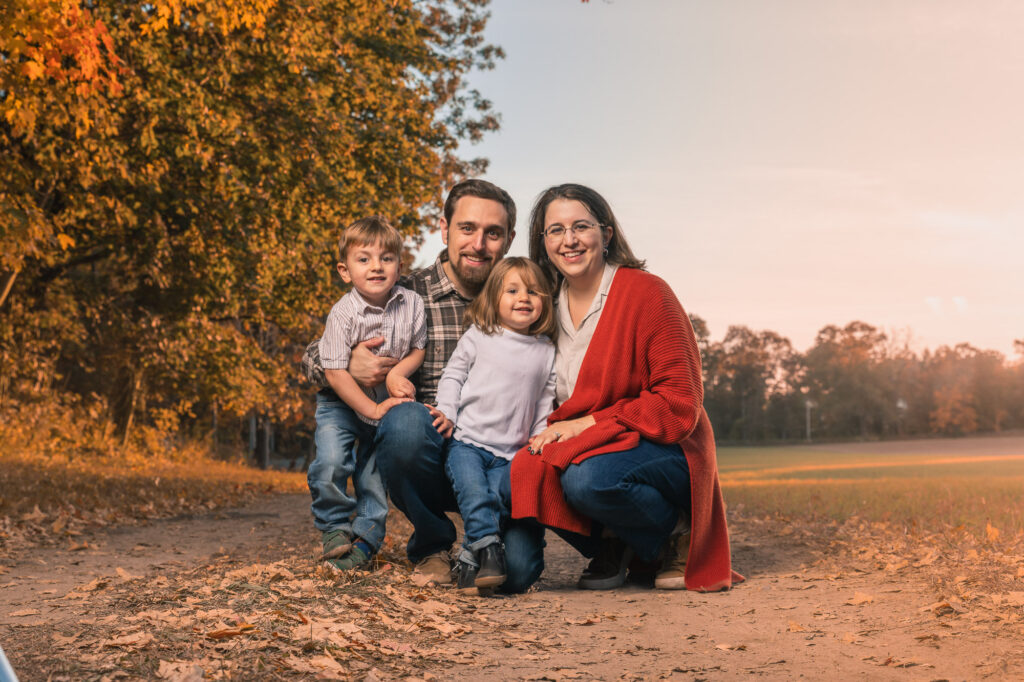
Bring more layers than you think you’ll need. A cardigan, a denim jacket, a flannel shirt you can tie around your waist if you’re feeling 1990s nostalgia. Mornings and evenings get cold fast, and there’s often no protection from wind in open outdoor locations.
Colors that work in fall:
- Navy and rust
- Cream and olive
- Jewel tones: emerald, burgundy, mustard
- Earth tones: browns, tans, muted greens
Fall does not mean you wear orange. I’m begging you.
Full disclosure: I’m not a fashion expert. I thought I had no style because my wife said so, but it turns out I do like the look of certain things more than others, so I do in fact have a style (take that, Sue). The point is I’m not going to tell you exactly what to buy. What makes me wince in any season is when families sacrifice comfort for what they think they’re supposed to wear. It shows.
One practical note: fall is one of the worst seasons for ticks in New England. Spray permethrin on your socks and around your ankles before you come, and do a tick check afterward. I know it’s not glamorous advice, but Lyme disease is also not glamorous.
What to Wear for Spring Family Photos 🌸
Spring in New England is unpredictable. It might be 60 degrees and sunny when you leave the house and 40 degrees and drizzling by the time you arrive. Dress in layers and have a backup plan.
Dresses work really well in spring. They photograph beautifully and feel seasonally right without trying too hard. If you want to lean into the spring vibe, a flower in your hair or a floral pattern can be a nice touch without going overboard.
Color depends more on your backdrop in spring than in other seasons. If you’re standing in front of white blossoms, wearing all white is going to wash you out. If you’re in a field of purple or yellow flowers, wearing those same colors might make you disappear into the background. Worth thinking about.
The ground can still be muddy or wet from snowmelt in early spring, so waterproof or closed-toe shoes are worth considering.
What to Wear for Summer Family Photos ☀️
Summer sessions are hot. So maybe skip the starched button-up shirt or anything equally miserable. Comfort matters, and if you’re sweating through your collar and tugging at your neckline, it’s going to show.
Shorts are fine. Cargo shorts are not. I don’t make the rules. (I mean, I guess I do, but it’s also just empirically true.)
This is also the season to lean into flowy dresses, fun jewelry, and accessories that move. Summer light is playful. You can work with that.
Bug spray. If your session is in the evening, you’re going to want mosquito repellent. Getting bitten is unpleasant, and you don’t want to be mentally calculating your odds of contracting West Nile virus while you’re trying to look happy in a photo.
Sunscreen. You’re going to be outside, usually in and around shade, but still. Use regular chemical sunscreen for photo sessions, not mineral. Mineral sunscreen doesn’t rub in fully and can look like clown makeup in photos.
What to Wear for Winter Family Photos ❄️
Winter is cold. Hot take, I know.
If your session is indoors or in-home, you have the most flexibility of any season. Cozy sweaters, bare feet, comfortable everything. It’s genuinely the easiest wardrobe situation there is.
If your session is outdoors, you need boots and jackets that actually keep you warm, because if you’re freezing, you’re going to look miserable, and no amount of editing fixes that. The hard part is that the jackets that are actually warm enough are often the ones with reflective tape on them and a logo for a waterproofing brand the size of a dinner plate.
If you’re going to invest in one piece of clothing before a winter session, a good coat is worth it. You’ll use it for photos, funerals, any time you need to look put together in cold weather. It doesn’t have to be expensive. It just has to be something you’d wear in front of people you respect.
Shoes for Outdoor Family Photos
Footwear is one of those things people don’t think about until they’re stumbling across uneven terrain in brand new shoes that are giving them blisters.
The universal rule: comfort over everything. You’re going to be walking around, not hiking a mountain, but also not standing in one spot for an hour. You need shoes you can actually move in.
What works:
- Clean sneakers (not the ones you mowed the lawn in)
- Boots, ankle or knee-high
- Flats with actual support
- Sandals in summer, with caveats below
What doesn’t:
- Brand new shoes you’ve never worn before
- Heels you can’t actually walk in
- Flip-flops (they photograph weird and you’ll spend the whole session concentrating on keeping them on)
- Anything with a sole so thin you can feel every root and rock
The Morning Dew Problem
Even in summer, early morning sessions mean wet grass. A lot of it. If you wear permeable shoes, you’ll get dew on your shoe, and you’ll feel like doo-doo. Waterproof or closed-toe shoes are your friend for any session before 10 AM, regardless of season.
A Note on Men’s Footwear
I’m probably harder on men’s fashion choices than women’s, only because I’ve made every mistake myself. I like big baggy pockets, comfortable ugly shoes, and hats that absolutely do not photograph well. I wish someone had been a little mean to me earlier, so I’m paying it forward.
Women can generally get away with sandals. Men’s sandals, on the other hand, tend to mean velcro Tevas or something equally horrendous.
If you’re a guy wearing shorts, some safe choices: boat shoes, clean white sneakers with low-cut socks, casual leather shoes, basically anything that isn’t neon green running shoes, athletic sandals, or calf-high white socks.
As long as your shoes are reasonably inconspicuous, they usually don’t show up that much in photos. The exception is when you’re wearing shorts, because now there’s a bare leg between the hem and the shoe and your footwear is fully exposed. But even then, comfort is what’s actually going to show up in the photos. There are ways to crop out or minimize ugly shoes. There’s no way to fix the expression on someone whose feet are screaming.
Farm Sessions: A Few Extra Considerations
If your session is at a farm, there are some practical realities and aesthetic opportunities worth knowing about. And if you’re still narrowing down locations, this guide to farm and outdoor photo spots near Boston might help.
Don’t Wear Anything You’d Be Devastated to Ruin
Farms are working environments. There might be grease on a tractor. There’s definitely dirt. Grass stains happen. And unlike most outdoor locations, there’s a non-zero chance you might step in something that came out of a cow.
Don’t put your toddler in a vest that was handed down through six generations and is made from the wool of an extinct breed of sheep. If getting a smudge of dirt on something would ruin your whole day, leave it at home.
The Terrain Isn’t Manicured
You’ll be walking around: the barn, the fields, maybe into the woods depending on the session. The ground is uneven. There might be gravel, mud, wet grass, or all of the above. Your shoes need to handle what is basically a casual hike.
Lean Into the Aesthetic (But Don’t Audition for Anything)
You don’t need to dress like you’re in a country music video, but leaning a little into farm fashion can look really nice in this setting.
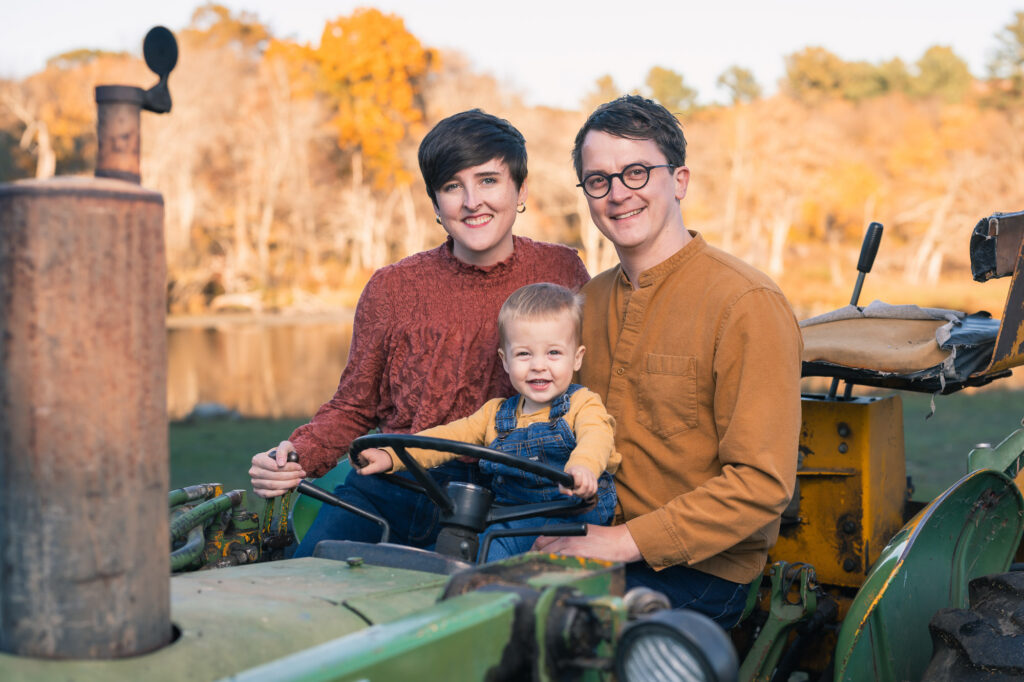
Things that work well: flannel, plaid, denim jackets, cowboy boots, vests (the normal kind, not the heirloom sheep wool kind). And suspenders. Everyone should wear suspenders. I’m not entirely joking. I’m in the process of converting to full-time suspenders myself because I don’t have much of a butt and belts never fit right, so suspenders have been revelatory for me personally. If you’re worried about whether you can pull them off, you can.
Cowboy hats, on the other hand, are tricky for photos because they cast shadows on your face. And going full rodeo aesthetic when you are not, in fact, a cowboy tends to look like a costume rather than an outfit. The goal is to feel like you belong in the environment, not like you’re performing for it.

Outfit Combinations That Actually Work
This is where people really start to spiral. How do we coordinate without matching? How do we make sure nothing clashes? What the hell is a jewel tone? Is mustard a jewel? Is rust the same as burnt sienna? If I screw this up, does it mean something about me as a parent?
You’re overthinking it.
Pick a color palette of three or four colors, and distribute those colors across your family. Nobody wears every color. Nobody wears the same amount of each color. The colors just show up somewhere, and together they feel cohesive.
Fall example: Dad in a navy button-up and khaki pants, Mom in a rust-colored top and jeans, kids in cream and muted green. Navy, rust, cream, a little green. Warm and cohesive, and nobody matches exactly.
Spring example: Dad in a light blue shirt and gray pants, Mom in a floral dress with blues and pinks, kids in soft pink or lavender with white or cream bottoms. The floral dress does all the work of tying it together.
Summer example: Dad in a white linen shirt and tan shorts, Mom in a coral or peach dress, kids in white, tan, maybe a pop of turquoise. Light, airy, works whether or not you’re anywhere near the beach.
Jewel tones (any season): Dad in emerald or forest green with dark jeans, Mom in burgundy or plum with dark jeans, kids in mustard, cream, navy. Rich and cohesive, especially against fall foliage or green fields.
And if your kid only has a blue shirt and your palette is rust and cream? It’s fine. We’re all going to die anyway. Don’t panic-buy a new wardrobe. Most photographers can work with it.
The Night Before
Everything in this section would theoretically be a good idea. I would theoretically do all of it, and then I would probably not do any of it.
The actual point is just: don’t try to figure out what anyone is wearing on the morning of the session. Decisions made in the fifteen minutes before you leave the house are going to be worse than decisions made the night before, and morning ironing is a fantasy that I have personally never successfully completed. Lay things out the night before, look at it all together as a group instead of as individual pieces, and then stop thinking about it.
Beyond that: a stain remover pen in your bag is never a bad idea, and if you have young kids, an extra change of clothes for each of them in the car sounds like overkill right up until it isn’t. But these are suggestions, not a checklist. Do what you can and let the rest go.
Frequently Asked Questions
Should everyone wear matching outfits?
Please don’t. Matching outfits read less like a family and more like a mandatory team-building event. What actually works is coordination: a shared palette of colors that shows up differently across everyone’s outfits. Nobody matches exactly, but everything feels like it belongs together.
Can you wear jeans for family photos?
Yes. Jeans are fine. Dark wash tends to photograph better than light wash, but wear what fits and feels good. The only thing to watch is fit — jeans that are too baggy or too tight can look awkward when you’re moving around, and you’re going to be moving around.
What colors should you avoid?
Neon anything, and logos or text on shirts. Bright colors pull focus and can make one person look like the entire point of the photo. Logos become the first thing anyone reads in an image, which is usually not what you’re going for. Beyond that, the main thing to avoid is wearing something that clashes with the setting. Orange in fall foliage sounds thematic but tends to disappear into it.
What should kids wear?
Something they’re actually okay wearing. A miserable kid in a perfect outfit is going to look miserable. Get a few appropriate options together and let them choose one — it gives them some ownership, which makes them more likely to cooperate. And if your six-year-old wants to wear a princess dress because that’s who she is right now, let her wear the princess dress.
My teenager doesn’t want to dress up. What do I do?
Don’t fight about it. If they wear all black and that’s genuinely who they are, let them wear all black. An outfit that feels like them will read better in photos than a coordinated one they resent. The fight about clothes is more likely to ruin the session than the outfit is.
Should I wear my glasses?
Yes. Your glasses are part of your face. A photo without them will look like someone who sort of resembles you. The one exception is transition lenses — wear your regular glasses instead, because transitions become sunglasses outside, and sunglasses hide your eyes.
Do I need to do my hair and makeup?
Do whatever you normally do, maybe slightly tidied up. The goal is to look like yourself, and more is not automatically better in natural light. If you want professional hair and makeup as part of your session, a lot of photographers, including me, offer that as an add-on. Just ask.
What shoes should I wear for an outdoor session?
Something you can actually walk in, that you’ve worn before, and that won’t get soaked if there’s morning dew on the grass. Clean sneakers, boots, flats with support. Brand new shoes that haven’t been broken in are asking for trouble. And flip-flops photograph weird.
What should I wear for a farm photo session?
Something you wouldn’t be devastated to get dirty. Farms are working environments — there’s dirt, there’s grease on equipment, and there’s a non-zero chance of stepping in something that came out of a large animal. Beyond that, leaning into the setting works well: flannel, plaid, denim, boots. The goal is to feel like you belong there, not like you’re performing for it.
When should I figure out what we’re wearing?
The night before, not the morning of. Decisions made in the fifteen minutes before you leave the house are going to be worse than decisions made the night before, and morning ironing is a fantasy I have personally never successfully completed. Lay everything out, look at it all together as a group, and then stop thinking about it.
The Bottom Line
There’s a version of preparing for family photos where you do all of this right. The palette is cohesive, the shoes were broken in a week ago, everything has been ironed and laid out the night before.
And then you arrive, and within about ten minutes, none of that is what anyone is thinking about anymore.
That’s the actual goal. Not the coordinated outfits, but the thing that happens after the coordinated outfits stop mattering, which is when you’re just there together, and the camera is somewhere nearby, and you’ve stopped performing for it. The self-consciousness lifts. The roles you play for each other in daily life, the managing and the logistics and the holding-it-together, fall away for a minute. What’s underneath is the thing that was always there.
The clothes just need to be good enough to get you there. They almost always are.
📷 And once you have the photos, here’s how to display them in your home without it feeling forced.
Looking for an outdoor family photographer in the Boston MetroWest area? Click Here to learn more about Corey Flint Photography